Hand and foot surgery often demands more than precise surgical technique. Small bones, narrow joints, tendons, and weight-bearing surfaces must work together after treatment. Orthopedic implants can provide stability while injured bone and soft tissue recover. Plates, screws, pins, wires, and joint-specific devices may help restore alignment and support controlled movement. Every millimeter matters.
The real question is not simply whether an implant is available. It is how to select orthopedic implants for hand and foot surgery according to anatomy, injury pattern, bone quality, activity level, and expected healing. Experienced surgeons review imaging, physical findings, medical history, and surgical goals before choosing a device. Material strength matters. So do implant size, profile, fixation method, and compatibility with surrounding tissue. A low-profile plate may reduce irritation near the skin, while a stronger construct may be necessary in a weight-bearing foot.
No implant choice is perfect. Patient response can vary. Swelling, delayed healing, hardware irritation, and later removal may occur, even after careful planning. That reality deserves honest discussion. Surgeons must also consider established clinical evidence, regulated manufacturing standards, sterilization, and reliable follow-up care. Patients should ask why a specific implant fits their condition and what alternatives exist. Clear communication builds trust.
Details guide decisions. A stable repair can support earlier rehabilitation, but movement must remain appropriate for healing. The best implant is not always the newest one. It is the carefully selected option that balances stability, safety, function, and long-term comfort.
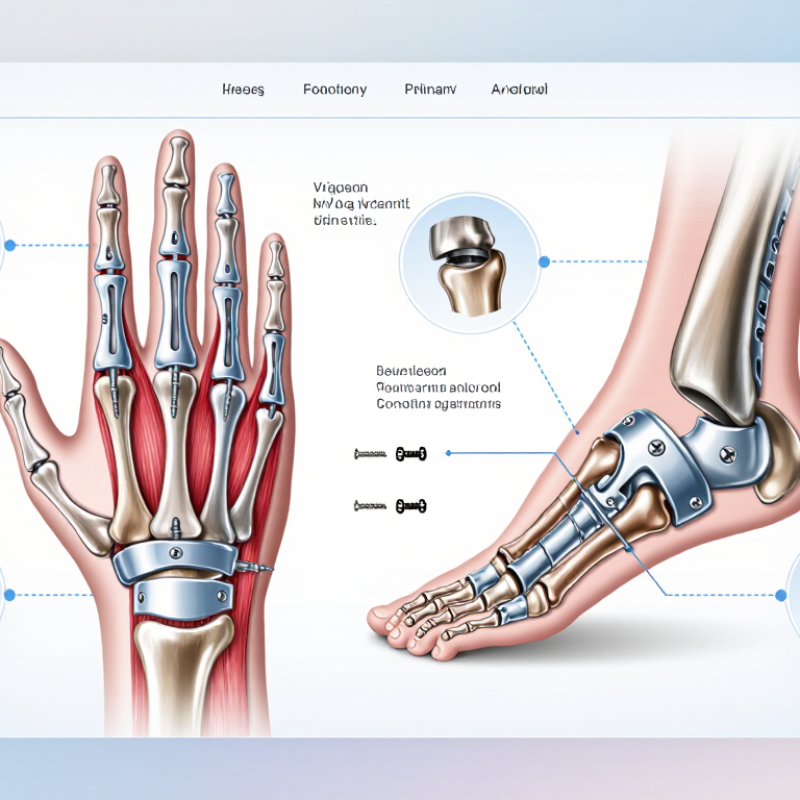
Hand and foot surgery often requires precise support for small, active bones. Orthopedic implants help maintain alignment while healing begins. The choice depends on the fracture pattern, bone quality, joint movement, and the patient’s daily demands.
Plates and screws are common for unstable fractures. A small plate can hold a broken finger bone in position during gripping and bending. Screws may compress the fracture and reduce unwanted motion. In foot surgery, plates can support the ankle, heel, or small bones near the toes. Their shape and thickness must match the anatomy. Too much hardware may irritate nearby tendons or soft tissue.
Kirschner wires, often called K-wires, provide temporary stabilization for delicate fractures and joint procedures. Surgeons may remove them after several weeks, depending on healing. Intramedullary screws can support certain toe, finger, or long-bone fractures from inside the bone. Joint implants may replace damaged surfaces in selected thumb, toe, or ankle procedures. They aim to preserve movement, but results vary with tissue condition and rehabilitation.
No implant is perfect. A device that looks stable on an X-ray may still cause stiffness or discomfort. Careful imaging, surgical planning, and follow-up remain essential. Patients should discuss implant removal, activity limits, infection risks, and expected recovery with a qualified orthopedic specialist. Small details matter, including shoe pressure, grip strength, swelling, and the timing of hand therapy.
Orthopedic implants may be recommended when a hand or foot injury cannot heal safely with casting, splinting, or therapy alone. Surgeons consider the fracture’s location, displacement, joint involvement, and stability. Pain alone is insufficient. Stability matters.
Implants are often considered for severely displaced fractures, open injuries, unstable joint damage, and bones that must regain precise alignment. In the hand, even a small rotational deformity can make fingers overlap during movement. In the foot, poor alignment may alter walking and increase pressure under the sole. Plates, screws, pins, or other fixation devices can hold bone fragments steady while healing begins.
The recommendation should follow a physical examination and suitable imaging. A clinician may also review circulation, nerve function, skin condition, bone quality, activity level, and medical history. Some patients need surgery because movement is essential for work or daily tasks. Others may heal well without an implant. This is not automatic.
Patients should discuss infection, nerve irritation, stiffness, delayed healing, hardware discomfort, and possible removal. Recovery can include wound care, controlled movement, and rehabilitation. Follow-up images help confirm alignment and healing. Even careful planning has limits. No scan predicts every outcome, and recovery may be slower than expected. A second clinical opinion can be reasonable when the recommendation remains unclear.
Orthopedic implants can help restore alignment when a hand or foot bone is fractured, unstable, or damaged by joint disease. Plates, screws, pins, and small joint components hold bone fragments in a controlled position. This stability gives healing tissue a better environment. It may also reduce painful movement during early recovery. In practice, surgeons choose implant size and position using physical examination, imaging, bone quality, and the patient’s daily demands.
The implant does not heal the bone by itself. It supports the repair while the body forms new bone around the injured area. Stable fixation can allow carefully guided movement, which may limit stiffness in the fingers, wrist, toes, or ankle. It can also help preserve joint alignment under normal loads. However, healing depends on blood supply, nutrition, smoking status, infection control, and rehabilitation. Small differences matter.
Not every patient needs an implant. Some injuries respond well to casting or other treatments. A careful surgeon weighs the expected benefit against risks such as irritation, loosening, nerve injury, or another operation. Follow-up visits and imaging help confirm progress. A patient may feel better before the bone is fully strong, so activity must increase gradually. That part is easy to underestimate. Even a well-planned procedure can heal slowly, and treatment sometimes needs adjustment.
Orthopedic implants can restore alignment when hand or foot joints are damaged by arthritis, trauma, or deformity. A small plate, screw, spacer, or joint replacement may reduce painful movement and support earlier rehabilitation. In daily practice, implant choice depends on bone quality, tendon balance, circulation, activity level, and the patient’s expectations. A metal screw is not a permanent guarantee.
Implant-based surgery also has limitations. Infection, loosening, stiffness, nerve irritation, hardware prominence, and repeat surgery remain possible. The National Joint Registry’s 20th Annual Report recorded more than three million hip and knee procedures, yet it does not provide equally robust surveillance for many hand and foot implants.
That evidence gap matters. Results from large-joint surgery should not be copied directly to smaller joints. Evidence is uneven.
For example, a 2022 systematic review in Foot and Ankle Orthopaedics reported generally favorable pain and function outcomes after first metatarsophalangeal joint arthrodesis, but complications and reoperations still occurred across studies. Hand implant studies often involve small patient groups and short follow-up periods. Patient selection can change the result. A smoker, a manual worker, and an older adult may face different risks. Recovery may include swelling, protected walking, splinting, or months of therapy. The implant can look precise on an X-ray while the finger or toe still feels stiff. Surgeons should explain implant survival, non-implant alternatives, rehabilitation demands, and what happens if the device fails, using current registry data and peer-reviewed evidence where available.
Recovery after hand or foot implant surgery is rarely linear. Pain may ease before strength returns, while swelling can remain visible for months. The American Academy of Orthopaedic Surgeons notes that foot and ankle swelling may persist for six to twelve months after surgery. This matters when patients judge progress too early. Surgeons usually protect the repair with splints, controlled loading, and wound checks. Hand patients may begin guided motion sooner, but only when fixation and soft-tissue healing allow it. Small movements matter.
Rehabilitation should match the implant, bone quality, and daily demands. A 2022 World Health Organization report estimated that 2.41 billion people worldwide could benefit from rehabilitation. That figure highlights a practical truth: access and adherence shape outcomes, not hardware alone. Therapists may use scar management, grip exercises, gait training, balance work, or gradual resistance. Exercises should not become a test of toughness. Increasing pain, drainage, numbness, or sudden loss of function requires prompt clinical review. Long-term follow-up can identify loosening, alignment changes, stiffness, or adjacent-joint overload. The American College of Foot and Ankle Surgeons emphasizes individualized recovery expectations because healing varies widely. I have seen patients improve steadily, then struggle after returning to work too quickly. That setback is easy to underestimate. Implant surgery can restore useful function, but it cannot erase aging, diabetes, smoking exposure, or poor movement patterns. Regular activity, appropriate footwear, hand protection, and honest review remain important years later.
| Implant or Technique | Common Clinical Uses | Primary Benefit | Typical Recovery Considerations | Rehabilitation Focus | Long-Term Considerations | Potential Limitations or Risks |
|---|---|---|---|---|---|---|
| Bone screws | Fracture fixation, osteotomies, ligament or tendon-related bone procedures, and small-joint fusion. | Provides compression and maintains alignment while bone healing occurs. | Protected activity is often required for several weeks. Weight-bearing or hand use depends on fracture stability, bone quality, and the operated site. | Edema control, protected range of motion, gradual strengthening, and return of grip or gait mechanics. | Many screws remain in place permanently when asymptomatic. Removal may be considered if there is prominence, irritation, infection, or another clinical indication. | Hardware irritation, loosening, malposition, delayed union, nonunion, infection, or nerve and soft-tissue irritation. |
| Plates and screws | Unstable, displaced, or complex fractures of the hand, wrist, ankle, and foot; corrective osteotomy; and selected fusion procedures. | Offers rigid or relatively stable fixation and helps preserve anatomical alignment. | Swelling and stiffness are common early issues. Bone healing commonly takes several weeks to a few months, depending on the procedure and patient factors. | Early motion may be introduced when safe; therapy emphasizes tendon glide, joint mobility, scar management, balance, and progressive loading. | Can support earlier controlled movement than less stable fixation in selected cases, but does not eliminate the need for healing time or rehabilitation. | Prominent hardware, tendon irritation, stiffness, infection, loss of reduction, or the possible need for later removal. |
| Kirschner wires | Small-bone fractures, temporary fixation, joint positioning, and selected pediatric or minimally invasive procedures. | Useful for precise stabilization when small fragments or temporary fixation are involved. | The treated area may require a splint or cast. Exposed wires need careful pin-site protection and are often removed after sufficient healing. | Maintaining safe motion in uninvolved joints, controlling swelling, and restoring movement after wire removal when permitted. | Often intended as temporary fixation. Follow-up imaging is important before progression of activity. | Pin-site infection, migration, skin irritation, stiffness, and accidental displacement. |
| Interfragmentary or intramedullary fixation | Selected fractures of the phalanges, metacarpals, metatarsals, and other small bones where alignment and rotational control are important. | Can provide stable fixation through a smaller surgical approach in appropriately selected cases. | Return to daily activities is gradual and guided by clinical examination and imaging. High-impact loading should wait for documented healing. | Focuses on rotational alignment, tendon excursion, range of motion, and progressive functional loading. | May reduce soft-tissue disruption in selected procedures, but implant position and bone healing remain important long-term factors. | Malrotation, implant prominence, loss of fixation, delayed union, or irritation of nearby tendons and nerves. |
| Arthrodesis fixation | Painful, unstable, or severely damaged joints in the thumb, fingers, midfoot, hindfoot, or ankle when motion preservation is not suitable. | Eliminates painful motion by creating a stable fusion in a planned position. | Protection may continue for several weeks or longer until fusion is confirmed. Foot and ankle fusions may require prolonged limitations on weight-bearing. | Gait retraining, footwear adaptation, adjacent-joint mobility, hand-function training, and gradual strengthening. | Pain relief can be substantial when fusion unites, but the fused joint no longer moves and neighboring joints may experience increased loading over time. | Nonunion, malalignment, hardware irritation, altered gait or hand mechanics, and adjacent-joint degeneration. |
| Small-joint replacement implant | Selected painful or damaged finger, thumb, or toe joints where preserving motion is a primary goal. | Aims to reduce pain while maintaining useful joint movement in carefully selected patients. | Recovery is highly dependent on implant type, soft-tissue condition, and therapy. Motion may improve gradually over weeks to months. | Structured therapy is essential for controlled motion, edema reduction, tendon balance, strength, and protection from excessive stress. | Implant longevity varies. Activity modification and long-term clinical review may be appropriate, especially after high-demand use. | Instability, stiffness, wear, loosening, dislocation, fracture, infection, or revision surgery. |
| Patient-specific fixation plan | Complex deformity correction, revision surgery, bone loss, malunion, or anatomy requiring individualized alignment planning. | Allows implant selection and correction strategy to be tailored to anatomy, alignment, and functional goals. | Recovery depends on the complexity of reconstruction. Additional imaging and staged progression may be required. | Individualized occupational or physical therapy, gait or hand retraining, and gradual return to work or sport. | Long-term success depends on correction durability, bone healing, soft-tissue balance, patient activity, and management of underlying disease. | Residual deformity, recurrent symptoms, nonunion, infection, neurovascular injury, or further surgery. |
| General recovery and follow-up | Applies to most hand and foot procedures involving internal fixation or joint reconstruction. | Regular review helps confirm healing, detect complications early, and adjust activity safely. | Pain and swelling often improve progressively, but stiffness, weakness, and sensitivity may persist for months. Bone and soft-tissue healing do not always occur at the same rate. | Follow the prescribed splinting, wound care, range-of-motion, weight-bearing, and strengthening plan. Avoid smoking because it can impair bone healing. | The final outcome is influenced by injury severity, circulation, diabetes control, bone quality, smoking status, adherence to restrictions, and therapy participation. | Seek medical review for increasing redness, drainage, fever, worsening pain, numbness, color change, calf swelling, or sudden loss of function. |
Recovery timelines are general clinical ranges rather than guarantees. The treating orthopedic surgeon and rehabilitation team should determine implant selection, weight-bearing, hand use, therapy progression, and follow-up imaging for each patient.
They hold broken or damaged bones in alignment while healing begins. Small bones need careful support.
It may help when casting, splinting, or therapy cannot provide enough stability. Severe displacement can matter.
Plates and screws support unstable fractures. Temporary wires, internal screws, and joint implants may also be used.
A small plate can maintain position during gripping, bending, or walking. Screws may reduce unwanted movement.
Temporary wires stabilize delicate fractures or joints. They may be removed after several weeks, depending on healing.
Yes. Hardware may irritate tendons, soft tissue, or nearby nerves. Stiffness can also occur.
Surgeons consider fracture location, joint movement, bone quality, circulation, skin condition, and daily activities.
No. Some fractures heal with support and rehabilitation. Pain alone does not decide treatment; stability matters.
Ask about infection, stiffness, activity limits, healing time, possible removal, and follow-up imaging. Details matter.
Recovery may include wound care, controlled movement, imaging, and hand or foot therapy. Progress can be slower than expected.
Orthopedic implants play an important role in hand and foot surgery by helping stabilize bones, restore joint alignment, and support healing after fractures, deformities, or severe joint damage. Common options include plates, screws, pins, wires, fixation devices, and joint replacement components. They may be recommended when bones are unstable, displaced, unable to heal properly, or when conservative treatment cannot provide sufficient function or pain relief. By holding structures in the correct position, implants can promote bone healing and improve long-term joint stability.
The benefits of implant-based surgery may include stronger fixation, improved alignment, and earlier controlled movement, although risks such as infection, implant irritation, stiffness, or the need for additional treatment should be considered. Recovery typically involves wound care, pain management, gradual weight-bearing or hand use, and physical therapy. Long-term results depend on bone quality, surgical technique, rehabilitation, and patient adherence. How to select orthopedic implants for hand and foot surgery should be determined with a qualified medical professional, based on anatomy, injury type, activity needs, and overall health.

HBM Medical